
Alt text: Bar chart comparing National Electricity Market capacity in gigawatts: 40 GW of committed and anticipated new generation and storage to the early 2030s, 15 GW of coal and gas retiring over the next decade, 9.1 GW connected during 2025-26, and 5.4 GW of data centre projects in the connection process. Source: AEMO 2026 Electricity Statement of Opportunities, 25 August 2026, and AEMO 'Digital demand surge', 1 June 2026
The proposed national standards exempt facilities below 30MW, apply baseline requirements between 30MW and 100MW, and apply substantial requirements above 100MW — or across a 150MW cumulative portfolio.
AEMO forecasts data centre electricity demand in the National Electricity Market rising from about 5 TWh in 2025-26 to 34 TWh in 2035-36, or roughly 3% of grid supply to roughly 13%.
All 5.4 GW of data centre maximum demand currently in the NEM connection process sits in two states, split roughly 60% New South Wales and 40% Victoria.
Legislation is expected in Parliament early in 2027. The decisions that follow will shape the price, location and lead time of Australian AI capacity for the rest of the decade.
1. What Canberra has put on the table
2. Why a grid forecast now belongs in an architecture review
3. The thresholds decide whose problem this is
4. The build is concentrated in two states
5. Water reads as trivial nationally and decisive locally
6. Frontier AI training comes with conditions attached
7. What we would change before the legislation lands
Most enterprise AI plans in Australia rest on an assumption nobody writes down: that when the workload is ready, there will be somewhere onshore to run it, at a price roughly in line with today's. That assumption is now the subject of an open policy design process, and the terms being drafted are about electricity and water rather than about software.
The Prime Minister set out the shape of the framework on 15 July 2026, and an Office of AI was established inside the Department of the Prime Minister and Cabinet at the same time. The consultation paper that puts numbers against the idea, Getting it right: Building AI infrastructure that works for Australia, was published on 17 September 2026. Submissions closed at 5pm AEDT on 9 October 2026. Legislation is expected in Parliament early in 2027, following consideration by National Cabinet.
The headline obligation is that large facilities must bring forward new renewable generation sufficient to fully offset their own demand — in the Prime Minister's phrasing, to be "net-generators, not net-users" — and retire renewable energy certificates equivalent to their annual consumption. Sitting alongside that are design efficiency targets, water efficiency measured against ISO/IEC 30134-9:2022, an obligation to cover transmission and network costs rather than pass them to other consumers, siting and community conditions, and workforce commitments.
This is not a compliance regime pointed at your IT estate. It is a regime pointed at the people who sell you capacity, which is a different thing and, in our experience, the harder thing to plan around.
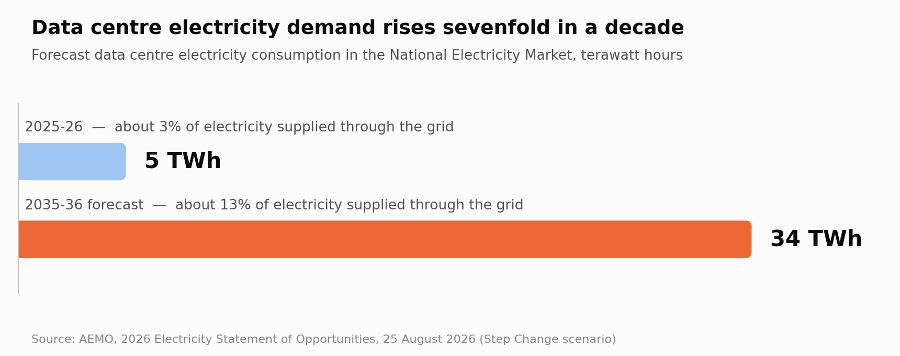
Alt text: Bar chart showing forecast data centre electricity consumption in the National Electricity Market rising from 5 TWh in 2025-26, about 3% of electricity supplied through the grid, to 34 TWh in 2035-36, about 13%. Source: AEMO, 2026 Electricity Statement of Opportunities, 25 August 2026, Step Change scenario
AEMO's 2026 Electricity Statement of Opportunities, published on 25 August 2026, forecasts data centre consumption in the National Electricity Market rising from about 5 TWh in 2025-26 to 34 TWh in 2035-36 under its Step Change scenario — from roughly 3% of grid-supplied electricity to roughly 13%. The same report puts total electricity demand growth above 40% over the next decade, against approximately 15 GW of coal and gas generation retiring and 40 GW of committed and anticipated new generation and storage expected by the early 2030s.
The hero chart above sets those numbers beside each other because the comparison is the point. A new load class is arriving at a grid that is simultaneously retiring a third of the capacity it is replacing. AEMO records 11 large-scale data centre projects above 5MW currently working through NEM transmission connection, representing 5.4 GW of maximum demand, and notes that connection typically takes around two years from application to energisation.
Two years is longer than most AI programme roadmaps. It means the capacity, siting and price of AI-capable compute in Australia are now downstream of transmission planning and generation investment decisions being taken now — which makes them a legitimate input to an architecture review, not a topic for the facilities team.
— Margarida Pimentel, Group Manager Onboarding and Connections, AEMO, 1 June 2026

Alt text: Bar chart showing proposed capacity thresholds for Australia's national data centre standards in megawatts: facilities below 30 MW excluded entirely, single facilities of 100 MW triggering substantial Tier 3 requirements, and cumulative portfolios of 150 MW triggering the same requirements. Source: PM&C consultation paper, 17 September 2026, page 8
The consultation proposes a tiered approach that excludes small facilities below 30MW altogether, applies baseline requirements between 30MW and 100MW, and applies substantially heavier requirements above 100MW or across a cumulative portfolio of 150MW or more. Herbert Smith Freehills Kramer's reading of the paper, published 23 September 2026, confirms the same figures including the portfolio aggregation rule.
TIER
CAPACITY
STATUS UNDER THE PROPOSAL
PRACTICAL CONSEQUENCE
Tier 1
Below 30MW
Excluded from the national standards
Covers essentially every enterprise-owned facility in the country
Tier 2
30MW to 100MW
Baseline requirements
Mid-size colocation; cost effects likely passed through in pricing
Tier 3
Above 100MW, or a cumulative portfolio of 150MW or more
Substantial requirements
Hyperscale and large colocation; where AI capacity actually lands
Read plainly, this means the direct compliance burden falls on hyperscalers, colocation operators and developers rather than on the enterprises buying from them. Almost no Australian corporate runs 30MW of its own IT load. What reaches you is indirect — through pricing, availability, contracted lead times and the obligations your provider has just acquired.
The portfolio aggregation rule is the part worth flagging to procurement. A provider holding several sub-threshold facilities can still be captured in aggregate, and how existing facilities are treated remains open: the government is weighing compliance plans tied to development milestones, legislated approval confirmations, or differentiated requirements based on how much influence an entity has over delivery and operation.

Alt text: Bar chart showing that New South Wales holds about 60 per cent and Victoria about 40 per cent of the 5.4 GW of data centre maximum demand in the NEM transmission connection process. Source: AEMO, 'Digital demand surge', 1 June 2026
AEMO reports that the 5.4 GW pipeline splits roughly 60% to New South Wales and 40% to Victoria, with 162 data centres operating nationally and a further 15 in Western Australia's South West Interconnected System. Every megawatt currently queued for NEM connection is therefore exposed to two state planning systems and two state energy markets.
That has a consequence most residency clauses miss. A commitment that data stays "in Australia" resolves in practice to Sydney or Melbourne. If a disaster recovery design assumes genuine geographic and systemic separation between primary and secondary sites, it is worth confirming that both are not sitting inside the same two grids, the same two planning regimes and, shortly, the same set of new obligations.
What this means for an ANZ enterprise New Zealand is moving in the same direction without the same instrument. On 27 July 2026, Prime Minister Christopher Luxon described work on a "compact" setting principles for hyperscale operators, built around additionality — the requirement that large facilities contribute new generation rather than draw on existing supply. The scale is already material: a NZ$3.5 billion AI data centre proposed at Makarewa near Invercargill would draw up to 280MW, second only to the Tiwai Point smelter among industrial electricity users. Greens co-leader Chlöe Swarbrick has proposed a one-year moratorium on new large-scale consents. For a trans-Tasman group, the practical effect is that both sides of the Tasman are converging on the same obligation, and a New Zealand subsidiary will most likely acquire it through its Australian parent's contracts before any New Zealand rule applies to it directly.

Alt text: Bar chart contrasting data centres' share of Australia's total industrial water use in 2025 at 0.04 per cent against Sydney Water's upper estimate of data centres' share of Sydney's drinking water by 2035 at 20 per cent. Source: PM&C AI infrastructure consultation paper, 17 September 2026, page 14, citing Sydney Water
The consultation paper reports that Australian data centres consumed an estimated 5.5 gigalitres of water for cooling in 2025, around 0.04% of the country's total industrial water use. It also cites Sydney Water's estimate that data centres could consume up to 20% of Sydney's drinking water by 2035. Both figures are in the same document, and both are correct; they simply measure against different denominators.
The proposed response is design Power Usage Effectiveness below 1.25 where potable water is used and below 1.34 where recycled water is used, or a NABERS 5-star rating as an alternative, with Water Usage Effectiveness reported against ISO/IEC 30134-9:2022. Uptime Institute’s 2026 Global Data Center Survey, published 28 July 2026 and covering more than 800 operators worldwide, found that only just over half of operators currently record their water consumption at all. A reporting standard is therefore landing on an industry where measurement is close to a coin toss.
Every forward-looking number here is a forecast or a proposal, not an outcome. The tier thresholds, the offset obligation and the efficiency targets are all consultation positions that may change before legislation. The demand figures come from AEMO's Step Change scenario, which is one scenario among several. AEMO's own June 2026 update placed the 34 TWh figure at 2050 rather than 2035-36; the August Statement of Opportunities is the newer forecast and is what the government's paper cites, but the revision is large and worth noting. Treat all of it as planning input, not as settled fact.
The second half of the consultation deals with frontier AI training conducted in Australia. Labs granted authorisation would be required to meet minimum security and safety expectations, including disclosing defined reportable AI incidents to Australian authorities. They would also be expected to invest in local capability, skills and research, and to improve compute access for Australian start-ups, small businesses, researchers, vocational education stakeholders and not-for-profits — potentially through negotiated in-kind contributions, a compute reservation scheme, or a public-interest research payment.
Creator protections form the third strand. The paper states that how copyright treats AI training will be a key part of the standards, with the Attorney-General leading a separate consultation on the options.
None of that binds an enterprise directly, and it would be easy to read past. We would not. Reportable AI incident disclosure sets a precedent that will shape what your own AI suppliers are obliged to tell you and when. A compute reservation scheme changes who gets access to Australian training capacity and on what terms. And the copyright settlement determines what provenance warranties you can realistically obtain from a model vendor operating here.
Four things are worth doing now, and none of them requires waiting for the final drafting.
Ask your hosting and AI providers, in writing, which tier their Australian facilities fall into, how they intend to meet the energy offset obligation, and whether the cost of meeting it is passed through under your current contract or at renewal. The answers vary considerably by provider and are much easier to get before an obligation exists than after.
Separate data residency from what might be called grid residency in your architecture documents. The first is a legal and contractual question; the second is a physical one about which grid, which planning regime and which water catchment your workload actually depends on. Most residency clauses answer only the first.
Re-test disaster recovery separation against the two-state concentration, and treat connection lead times — around two years from application to energisation — as a real constraint on any plan that assumes new Australian AI capacity will simply appear when needed.
Finally, set a dated review trigger for the legislation in early 2027 rather than leaving a standing watching brief that nobody owns. The shape of the standards will be visible well before they commence, and the organisations that adjust their contracts during drafting will have considerably more room than those renegotiating afterwards.
This article has been prepared using information available in public sources as at the date of publication. Digital400 accepts no liability for the accuracy, completeness or currency of the information presented, or for any decision taken in reliance on it. Readers should obtain their own professional advice before acting.
Almost certainly not. The proposal excludes facilities below 30MW, which covers essentially every enterprise-owned facility in Australia. The obligations fall on large operators and developers, and reach enterprises indirectly through pricing, availability and contract terms.
No. The consultation paper published on 17 September 2026 sets out proposals. Submissions closed on 9 October 2026, and legislation is expected in Parliament early in 2027. Thresholds and obligations may change before then.
It does not say that. AEMO's 2026 Statement of Opportunities reports an improved reliability outlook, supported by 9.1 GW connected during 2025-26 and a 40 GW pipeline of committed and anticipated projects. The forecast describes a new load class arriving during a period of major supply turnover, which is a coordination and timing question rather than a shortage claim.
Because the obligations attach to the facilities where AI-capable capacity is actually built. Underwriting new generation, covering transmission costs and meeting efficiency targets all carry cost, and that cost sits in the supply chain that prices your capacity.
Nationally, data centre water use was around 0.04% of Australia's industrial water use in 2025. Locally it can be decisive — Sydney Water estimates data centres could take up to 20% of Sydney's drinking water by 2035. The proposed standards respond to the local figure, not the national one.
New Zealand has no equivalent legislated standard. The government has signalled work on a compact with hyperscale operators built around additionality. For trans-Tasman groups, the obligation will in most cases arrive contractually through Australian arrangements before any New Zealand rule applies directly.

Basilu Weerakoon
Cyber Security & Compliance Intern
Blog